
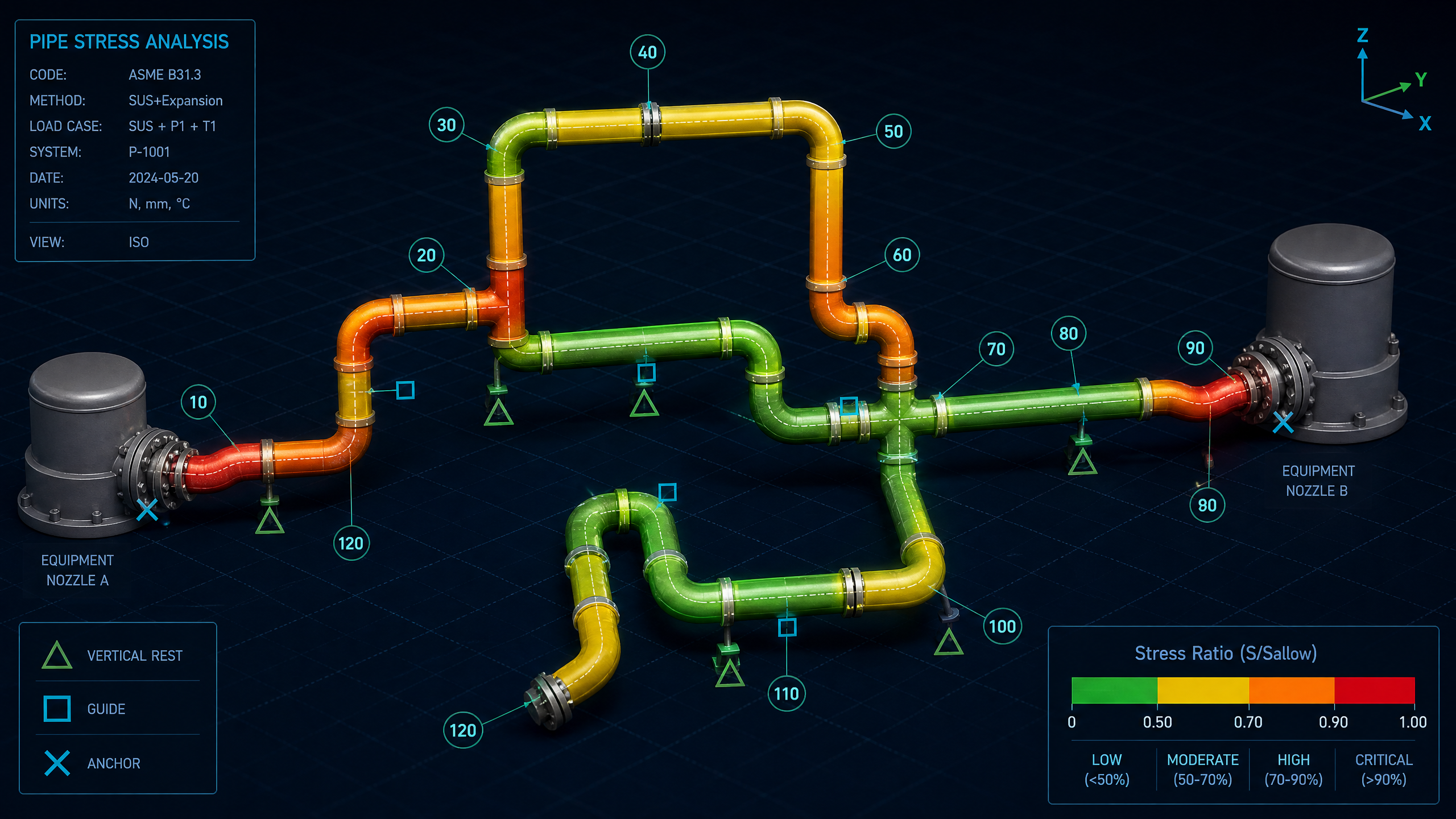
Know when a piping issue needs an engineering basis
A new routing, tie-in, temperature change, equipment replacement, support modification, vibration concern, or change in operating condition can alter movement paths and load transfer across piping, supports, structure, and equipment interfaces. Symptoms such as repeated support distress, leakage, misalignment, or vibration should be evaluated against the actual geometry and operating data rather than corrected by a one-off field change.
The governing code and project requirements must be confirmed for the specific system. ASME B31.3 applies to process piping within its stated scope, but code selection depends on the service, facility boundary, jurisdiction, owner requirements, and contract scope.
Build the model around verified load cases and restraint assumptions
A defensible evaluation begins with field-verified geometry and inputs: line size and material, temperatures, pressures, fluid state, insulation, valves and specialty items, support conditions, equipment data, expected movement, and relevant transients. The analysis basis should make assumptions visible and identify field validation needed before construction.
Design considerations can include weight, thermal expansion and contraction, dynamic effects, support or anchor movement, terminal movement, and cyclic behavior. Supports have different functions—carrying load, guiding movement, or anchoring the line—and the restraint direction selected changes how forces are transferred through the system.
Turn analysis into constructible corrective work
A useful work package goes beyond a result plot. It can define the operating cases, restraint schedule, support concepts, fabrication or installation details, equipment-interface checks, vibration-assessment inputs, and field-verification notes needed for procurement and construction.
For covered process-safety-management systems, mechanical-integrity procedures, inspection/testing practices, and records have additional importance. Grey Engineering can pair pipe stress and hydraulic review with support design, fabrication coordination, 3D field capture, and PE-sealed engineering deliverables where appropriate.
These public references support the planning context in this guide. Final project requirements must be confirmed for the specific facility, scope, authority, and contract.